A Lesson from Small Beginnings

Nazareth is our next stop. You recognize it immediately as where Jesus grew up.
Although it is a little more than an hour’s drive on Hwy 90, 1200 years separate when the Dan tribe lived and when Jesus grew up! Talk about time travel! It’s all over Israel. You drive between the pages of history wherever you go.
While there, I visited the Nazareth Village re-creation. It is a startling return to a much simpler lifestyle. Someone in costume led a donkey down the powdery limestone path. The donkey was the “truck” of this period. Their dense bone structure, sure footing, and endurance made them perfect for back roads and mountain trails.
Did Mary and Joseph use a donkey to return home from Egypt? Was it tethered in front of their first house? Was it the same one they used to travel to Bethlehem? We can only imagine.
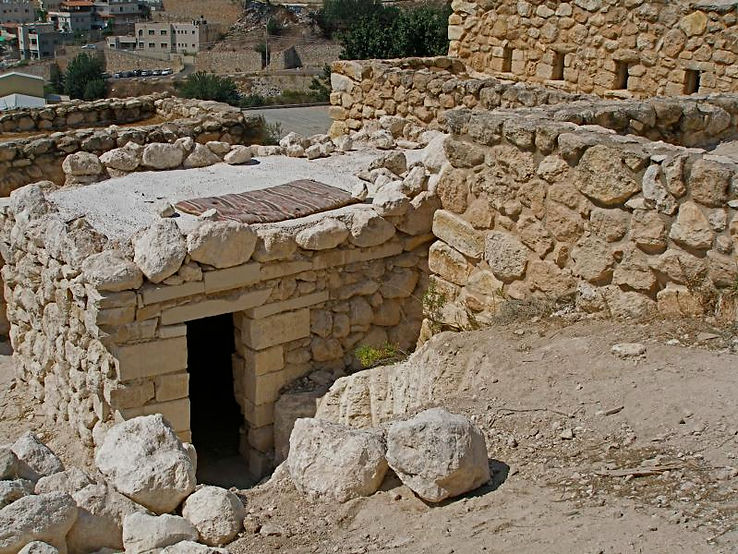
The village houses are white mud-and-limestone structures. Windows were high to increase airflow and give privacy.

Open shelf concept is not a new design. No cabinets here. Quick access and only one place to return what you used.
Olive trees anchor Israel because they can live 400-500 years. Their twisted branches reach toward the sun with handfuls of silver-green leaves and share valuable shade. Shade is as important here as water here!

Our walk takes us past a burial cave. It looks just like the pictures we’ve seen of Jesus’ open tomb. We learn a little about burial. Bodies must be buried within 24 hours. Each family has a burial cave. When there is a death, the body is quickly wrapped and placed in the front part of the cave. One year later, they return to “collect” the bones and place them in a receptacle to store farther back in the cave. Then, the cave is ready for the next death.
I felt I had traveled back in time. I could almost believe I had traveled back in time to the village where Jesus grew up. It was where he found friends, learned Hebrew, worked in the carpentry shop, and grew in favor with God and man.
Was Nazareth and Jesus’ growing-up years simply the calm before the storm? I don’t think so. I believe it emphasized his coming into our world, fully human. He had to learn that bees sting and sharp rocks cut bare feet. He went to the synagogue to study the Torah just like the other boys. He needed sleep, food, play, and his parents’ love and support. But what he did with his simple lessons changed history.
Nazareth didn’t have a positive image in Jesus’ day. It was a small village of about fifty houses on 900 square feet. Many believe that families from David’s line settled there. It would mean everyone was related. Think of that in connection with Mary's pregnancy without a husband! Even Nathaniel, whom Philip recruited to meet Jesus, didn’t have positive expectations when he said, “Can anything good come from Nazareth?” (see John 1:46)
Today, we know the answer is yes. Something good did come from Nazareth. Jesus demonstrated that it’s not where you begin or who you begin with that makes the most significant difference; it’s who you become and whose you become. He teaches us the same lesson. We don’t ignore negative beginnings, but we can’t let them prevent what God has promised to do in and through us.
Nazareth reminds us that good things come from small beginnings. Zechariah reminds us of the same truth when he counseled the Jerusalem rebuilders not to despise small beginnings. (See Zechariah 4:10, TLB)
Do you entertain what I call obstacle thinking? That’s when you think that if you’d had a better beginning, better parents, better education, or whatever you put behind the word better. That thinking leaves God’s creative work sidelined.

Perhaps you have heard this statement before: “God has a tendency to pick up a nobody, to become a somebody, in front of everybody, without asking anybody.” (Anonymous) It means that small beginnings, even negative ones, in the hands of our God of All Beginnings, create something we couldn’t create without him. We need to stop blaming or complaining about what didn’t happen and begin looking at how God is trying to get our attention through it.
Jesus didn’t let a humble beginning keep him from what his Father planned for him. We shouldn’t either. Who we become in God should always be bigger and better than where we started.


Comments